Unlocking Lyme by William Rawls
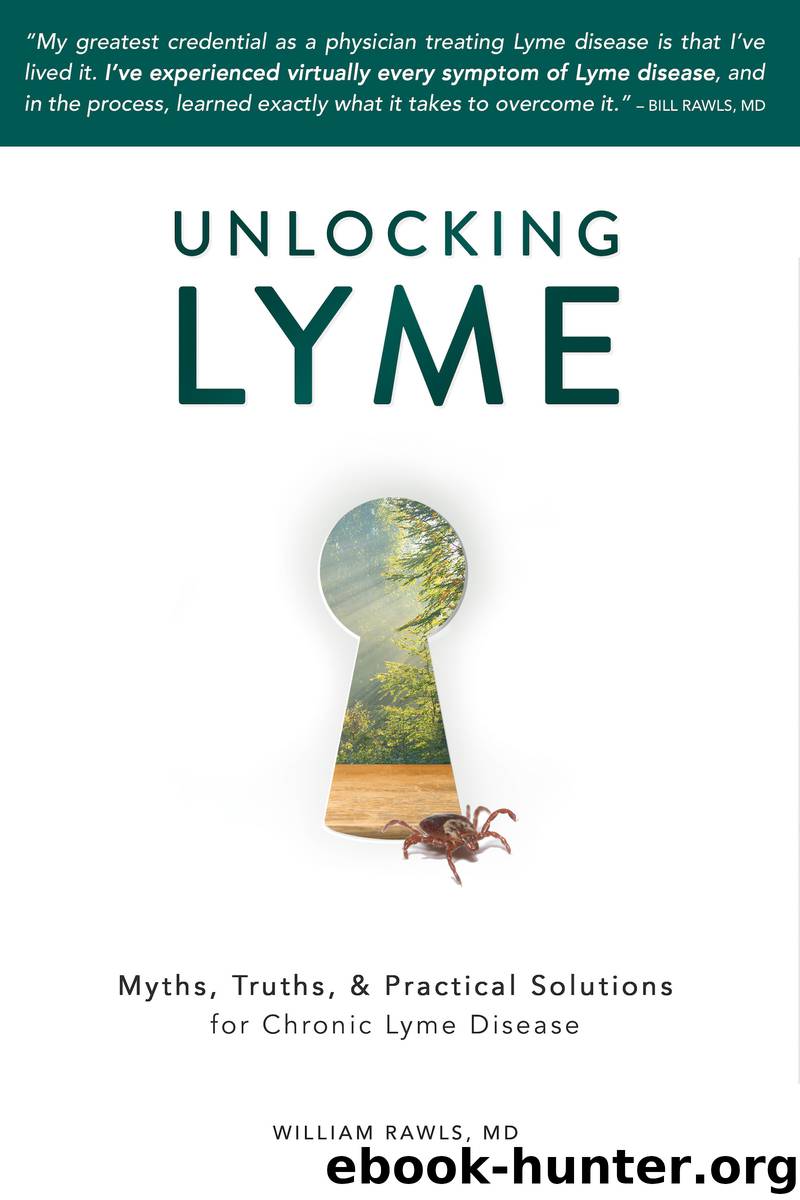
Author:William Rawls
Language: eng
Format: epub
Publisher: William Rawls
Published: 2017-02-04T05:00:00+00:00
Medications for Sleep and Anxiety
Sleep is essential for your recovery, and on occasion, you may need something potent to get you there. Generally, this means drug therapy. While drug therapy is never the ideal solution, sometimes it’s the only solution. When drugs do become part of the solution, however, they need to be used carefully and respectfully to avoid long-term consequences. All drugs used for sleep and anxiety carry the potential for habituation. Drug habituation will slow your recovery!
The classic sleeping pills (Ambien, Lunesta, Sonata) are generally best avoided. They are very effective for inducing sleep, but use of them one night causes rebound insomnia on the next night. This provides an ever-present incentive to use them on the following night and every night thereafter. Habituation occurs rapidly and, once you are habituated, sleeping pills are extremely hard to stop. Eventually, they quit working completely, and insomnia becomes a nightmare of the worst kind.
When your nervous system so agitated that sleep just won’t come, the long-acting benzodiazepine, Valium (diazepam), is a better choice for breaking the cycle. Because it stays in your system for over 30 hours, next night rebound insomnia is less apt to occur. Valium also provides muscle relaxing properties that are not provided by classic sleeping pills. Like all drugs in this class, however, Valium is extremely habituating. Save it for when you really need it and avoid regular use. Ask your doctor for the 5-mg tablet. A half-tablet will often work, but you can safely take up to 10 mg (two 5-mg tablets) in a 24-hour period. Klonopin is a similar long-acting benzodiazepine.
Xanax (alprazolam) or Ativan (lorazepam) are short-acting benzodiazepines that are ideal for acute anxiety or panic attacks. These drugs stay in your system for 6-12 hours. Because they are short acting, they are less useful for sleep; rebound insomnia becomes a problem. The average dose for these drugs is 0.25 to 1 mg up to every 6 hours. Use the lowest dose possible to achieve benefit.
As much as benzodiazepines can be your best friend when used acutely and occasionally, they become your worst nightmare if used every day (or every night). Benzodiazepines are possibly the most habituating substances on earth (even more than heroin). The habituating tendency of these drugs must be respected! Reserve use of these drugs for crisis situations only.
Lioresal (baclofen) is a muscle relaxant that also can be used for sleep and anxiety. It does have habituating tendencies, but less so than sleeping pills or benzodiazepines. Ask for 10-mg tablets, but start with only half a tablet. The top dose for muscle spasm is 20 mg three times daily, but you should try to avoid using that much. Avoid regular use.
Neurontin (gabapentin) is typically used for treating nerve pain in extremities, but it also has sedative properties; some people find it valuable for sleep and anxiety. It is less habituating and does not cause addiction problems like classic sleeping pills and benzodiazepines. It can be taken continually, but it loses sedative properties with chronic use.
Download
This site does not store any files on its server. We only index and link to content provided by other sites. Please contact the content providers to delete copyright contents if any and email us, we'll remove relevant links or contents immediately.
| Administration & Medicine Economics | Allied Health Professions |
| Basic Sciences | Dentistry |
| History | Medical Informatics |
| Medicine | Nursing |
| Pharmacology | Psychology |
| Research | Veterinary Medicine |
Periodization Training for Sports by Tudor Bompa(8325)
Why We Sleep: Unlocking the Power of Sleep and Dreams by Matthew Walker(6780)
Paper Towns by Green John(5246)
The Immortal Life of Henrietta Lacks by Rebecca Skloot(4639)
The Sports Rules Book by Human Kinetics(4447)
Dynamic Alignment Through Imagery by Eric Franklin(4262)
ACSM's Complete Guide to Fitness & Health by ACSM(4087)
Kaplan MCAT Organic Chemistry Review: Created for MCAT 2015 (Kaplan Test Prep) by Kaplan(4049)
Livewired by David Eagleman(3810)
Introduction to Kinesiology by Shirl J. Hoffman(3804)
The Death of the Heart by Elizabeth Bowen(3675)
The River of Consciousness by Oliver Sacks(3635)
Alchemy and Alchemists by C. J. S. Thompson(3555)
Bad Pharma by Ben Goldacre(3462)
Descartes' Error by Antonio Damasio(3315)
The Emperor of All Maladies: A Biography of Cancer by Siddhartha Mukherjee(3203)
The Gene: An Intimate History by Siddhartha Mukherjee(3128)
The Fate of Rome: Climate, Disease, and the End of an Empire (The Princeton History of the Ancient World) by Kyle Harper(3088)
Kaplan MCAT Behavioral Sciences Review: Created for MCAT 2015 (Kaplan Test Prep) by Kaplan(3020)
